

Countries 8 and 9: Latvia and Lithuania
- Mike Eynon
- Jul 31, 2024
- 6 min read
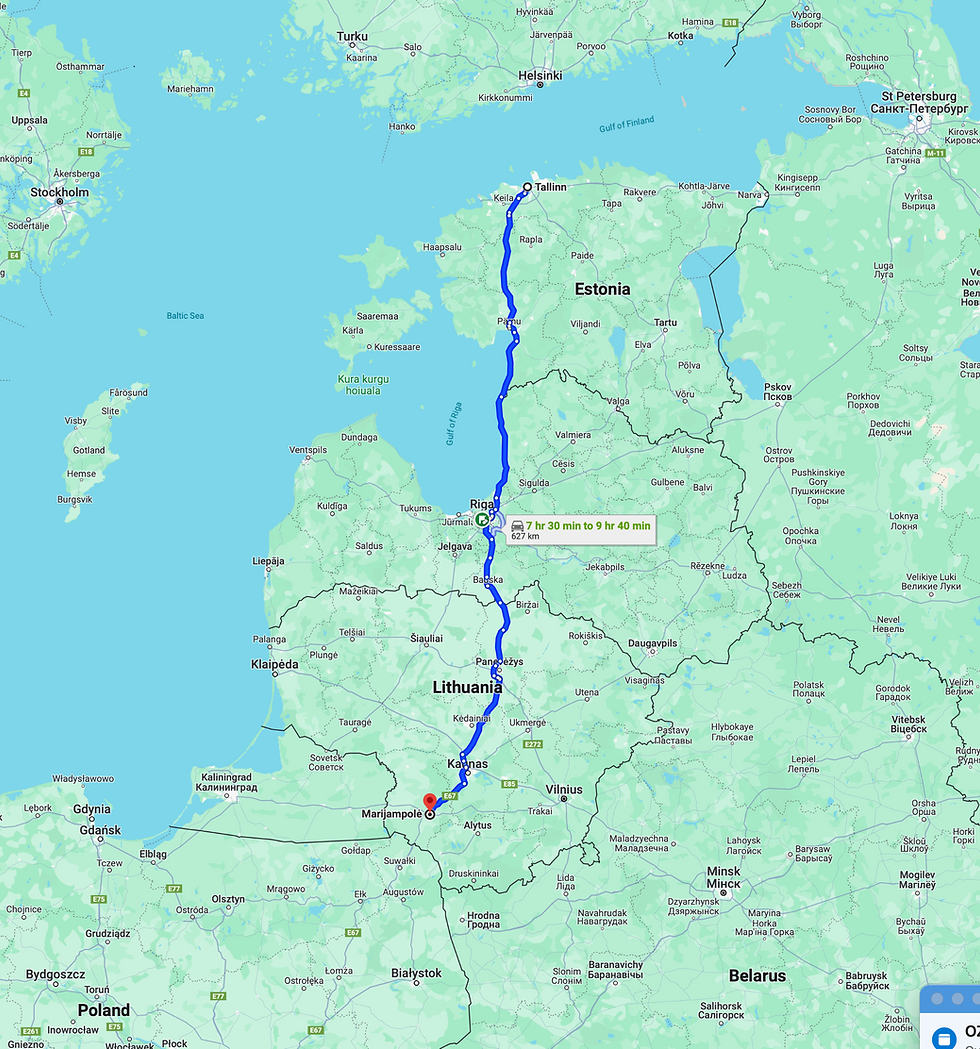
As Americans, our family knew the least amount about the Baltic nations in Europe. We knew a little about Estonia from Laura's and my time at eBay in the early 2000’s when we met with some of the early Skype team, but even with that, I’m not sure I could have correctly pointed to Estonia, Latvia and Lithuania on a map.
Along with my geographic ignorance, I also must admit to knowing very little about the history of the region - and this is absolutely critical to understanding these countries today.
An abridged intro to Baltic history -
The three Baltic nations were created at the end of WWI in 1918. All three were independent and thriving until 1939 when Hitler and Stalin signed the Molotov-Ribbontrop Pact. In short, Germany would take Poland and a few other counties while Russia would take Estonia, Lithuania, Latvia and Finland. In other words, where we only hear about the German Blitzkrieg, the Russias in 1939 engaged in the same fast moving offensive to take all the Baltic countries. The Russians were equally brutal as the Nazis in their conquest and oppression.
In 1941, the Nazis turned on the Russians and decided to take the Baltics for themselves, and treated the Baltics with equal violence and cruelty. In both cases, the Nazis and the Russians conscripted Baltic men involuntarily (ironically called “voluntary regiments”) into their militaries. This meant that multiple sets of brothers and fathers and sons were forced to fight against each other during WWII.
At the end of WWII, Stalin negotiated with Churchill and Rosevelt that Russia would retain the Baltics (and others) as part of the Soviet Union. The people of the Baltics attempted to fight the oppression and occupation, which led to the most brutal part of this history from 1945 through the fall of the Soviet Union in 1991; all while the west turned a blind eye.
One stat sums up the Russian occupation and oppression of the Baltics more than any other. Between 1945 and 1953 when Stalin died, one-third of Latvians were kidnapped or killed by the Russians. They were either systematically murdered in Latvian KGB (Checka) kill-rooms, shipped to Moscow for execution, shipped to Russian labor camps located throughout Russia (where most died), or were imprisoned in Siberian gulags where most died. Hundreds of thousands of Baltic people were wiped from the face of the Earth at the hands of violent Russian brutality and oppression.
After Stalin died, the number of disappeared Baltic citizens reduced, but did not end. Rather than execute people in the Baltics, political prisoners were shipped to Russian where no one knew their fate, but few returned. This reduced the likelihood of anyone discovering more of the mass graves of Latvians killed in and around Riga. During this time, Russia continued to institute forced labor and robbed the Baltics of their natural resources which were sent back to Russia to try and bolster the failures of Communism. All the while, the people of the Baltics resisted in the face of torture, imprisonment and death.
During this time, historic buildings were torn down and replaced with Russian buildings. The Latvian languages were replaced with Russian. Most anything Baltic was replaced with something Russian in an attempt to erase entire cultures.
In the late 1980s, the plight of the Baltic peoples was finally becoming known to the west. At the same time, the Soviet Union was beginning to unravel. Poland and Czechia were gaining world attention and the Baltics were engaged in very visible non-violent protests. Eventually, the Soviet Union collapsed, and the Baltic countries (along with all of the ‘Iron Curtain’ countries) were once again independent nations. This did not occur until 1991. (For Laura and I this seems to be very recent.)
This is difficult to put into words, but there’s a feeling of rebirth and hope in the Baltics. There’s a discernible focus on the future without forgetting the past, but not letting the past impact their future.
One big example of this is that 38% of the population of Riga (similar populations in other Baltic cities) are Russians who relocated during the Russian occupation. There’s no animosity between the native Baltic people and the Russian immigrants. The natives all say they welcome Russians to live in work in their countries, and are even positive about keeping the Russian border crossings to their countries open. Conversely, they are fiercely against imperialism, and staunch supporters of Ukraine right now. Many places we visited flew a Ukrainian flag, and some attractions listed free tickets for Ukrainians. Although most Baltic people are friendly to Russians, they are openly unhappy with Putin and his government. This paradox is especially poignant being that these people have a recent memory or how horrific life is under Russian occupation.
One contrast we saw between Latvia and Estonia was that Estonia seemed to be "further along". We hypothesize this is because the Estonians invested in computer science education starting in the 60's. This means that Estonia now has a fairly robust startup ecosystm (including Skype, Bolt and Wise - the latter two are major companies in Europe). Unfortunately, Latvia and Lithuania did not invest in this type of education as early as Estonia.
And now to OUR TIME in Latvia and Lithuania…

We arrived in Riga during a severe rain and wind storm (30mph winds!). We were originally planning to Zorb down a mountain for one of our field trips, but the organizers canceled for safety. As a result, we arrived late in Riga, found a restaurant for dinner, and then retired for the evening.

The next day was the brunt of the storm. We were forced to limit our excursions to museums INSIDE… but even that was problematic because some of the staff were unable to get to their jobs. The entire city of Riga was under a ‘red-alert’ because of the storm. Finding a place to eat proved challenging as many restaurants were either closed due to lack of staff or flooding. For us, this was part of the adventure of traveling. We were able to visit the Russian occupation museum, and a Checka (KGP) interrogation house with underground cells and kill room. It’s difficult to convey how horrific these were, but again furthered our understanding of the strength and resilience of the Latvian people.
The next day was finally clear enough for us to really get out and explore the city. We signed up for a walking tour with a local guide. As expected, Riga is a beautiful city. Like all Euro cities, they have an Old Town. It was a great tour with tons of rich history. In the case of Riga, the Latvians had to rebuild their Old Town after the Russians left. Luckily, they did a great job of retaining historical knowledge of all the city landmarks from about 800AD onward.

After our walking tour, we had an incredible lunch, loaded up the car, and were off to Lithuania.
Lithuania is probably the most remote and underdeveloped of the three Baltics we’ve visited. This is immediately apparent by it’s road system. As soon as we crossed the border from Latvia to Lithuania, the road narrowed, the center barrier disappeared, and the speed-limits dropped. For the most part, it was near impossible to pass anything. If you got behind a slow moving truck, you were pretty much there until the truck turned off to another destination. Because there’s only a single lane in each direction for 95% of the road that runs from the top of the country to the bottom, traffic in both directions is pretty high. Also complicating matters is that summer seems to be the time when road construction and maintenance happens. More than once, Google routed us off the highway to even skinnier roads (sometimes dirt) that ran through remote towns and villages. This was mostly a great experience except the speed limits were all over the place with seemingly random values… and there were speed cameras everywhere, but especially where the speed limits changed.
We stopped for dinner in Kaunus which appears to be the second largest city in Lithuania next to Vilnius. Because our trip needed to be shortened for us to make it back for the Olympics, Vilnius was dropped in favor of Marijampole, which is a small town halfway between Riga and Warsaw.
We originally wanted to stay at the one large hotel in Marijampole, but it was fully booked. Instead, we stayed at ‘the other’ hotel. Where ‘hotel’ was a very generous term. The “Torino Lounge” was closer to a hostel than a hotel. We had 4 single beds, and a shared bathroom with about 20 other Russian dudes (Laura was the only woman) who were also road-tripping through Lithuania… and spoke no English. Everyone was very cordial and nice, but it was a very different hotel experience… but it was better than sleeping in the Cayenne!


That's super helpful, Greg. Makes a ton of sense.
The Russians in Latvia also own most of the businesses and bring in most of the money. In some ways, the Latvians also need to like the Russians or they can't get jobs. There are plenty of similarities with Ukraine and the US and countries we are in as a nation.
Beautiful place. Beautiful people. Glad you are able to experience it all.
Thanks for all the history. It shows the true resilience of people trying to hold on to their history in the face of true brutality. Glad you’re safe through all the bad weather. It’s been raining again in Paris at the Olympics. It’s been quite exciting to watch all the events. Drive safe and have a great time at the Olympics. Enjoy the pastries in Paris.