

Ukraine road-trip – part 1
- Mike Eynon
- Mar 30, 2025
- 5 min read
And there I was - entering Kyiv from the direction of the eastern front, driving a loaded down big red van with Dutch license plates as a foreigner with an American passport being waved to a stop by a teenager with a machine gun at a full military checkpoint.
I’ve always wondered what the inside of a Ukraine prison looked like…

Yes. I drove from Amsterdam to Poltava, Ukraine. Without getting mired in politics, the short explanation is that I could no longer sit by and do nothing. Unlike America, the effects of the Russian invasion of Ukraine are visible in Europe in nearly every direction you turn. It’s also the case that most Europeans I encounter, even here in Amsterdam which is more than 1500 miles from the fighting, do something to materially ease the suffering in Ukraine. In other words, it’s difficult to think of yourself as a ‘good person’ without doing something while everyone around you is doing their part.
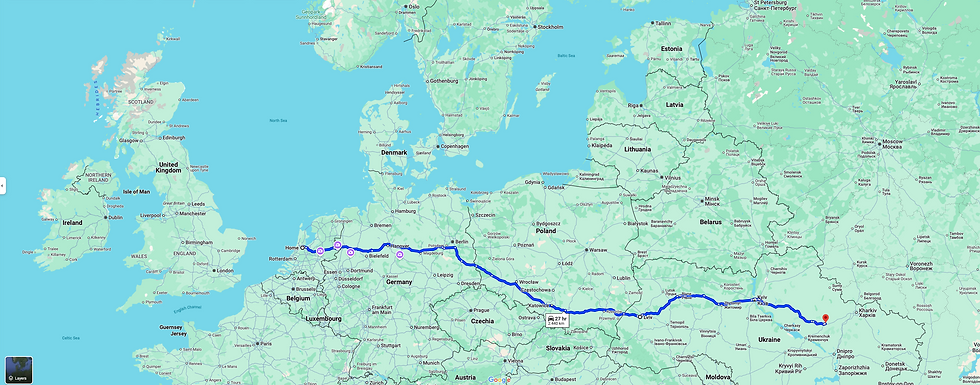
At the end of February, one of the groups I volunteer with put out a call for drivers willing to deliver vehicles and emergency supplies into Ukraine. With US aid and intelligence being halted, outside aid even from normal citizens became increasingly important for Ukraine’s survival. After a brief conversation with Laura, I signed up to be a part of a convoy that would leave the Netherlands on March 11. A single blog detailing all of the preparation, traveling, and returning home would be far too long, so I’ve chosen to break this into a mini-series of sorts.
Preparation
Within days of signing up, I was invited to a meeting to discuss the trip. The organizer of the trip was a local Amsterdamer who had raised funds for Ukraine, but had never undertaken anything of this scale. He made it clear that the trip’s success would rely heavily on information and experience from other NGOs, and the willingness of the group to be flexible in handling issues as they arose. Although Paul had raised enough money to cover the vehicles and all of the emergency supplies to be packed in them, each volunteer would be responsible for paying all the costs for getting their loaded vehicle where it needed to go. The final statement was, “Once you deliver your vehicle, it’s your responsibility to get home.” Yes… that was a bit of a shock to hear - it would be my responsibility to figure out my own way home from a country at war.
I’m a CTO… how hard can this be?

In the meeting, it also became apparent that downtown Amsterdam would be the worst place to coordinate vehicles and supplies. After a quick check with my VERY GENEROUS neighbors, it was decided that Laura’s and my house would be where all seven of the vehicles would be parked, and my garage would house the more expensive items we did not want to chance being stolen from locked vehicles.
Within a few days, our little street with four houses tucked away in a mostly quiet and hidden part of Amsterdam became a bustling staging area filled with cars and large vans, frequent deliveries of supplies and nearly constant action as each vehicle was prepped and loaded.
Keep in mind everything was either donated or bought on the cheap. The local grocery store chain, Albert Hein, in conjunction with another local charity donated between 3000 and 4000 pounds of food. Batteries and generators were bought at cost (or below) from local suppliers wanting to do their part to help. And then there were the cars…
The vehicles were a mix of donations and ‘very good deals’. In order for a car to be legal on the road, it must pass a strict MOT test that requires all vehicles to be in good working order on the road. This meant that all our vehicles met a solid minimum standard. Unfortunately there is no MOT test for odor!
My particular car was a Subaru Forester. Surprisingly, 1999 - 2005 Foresters are a great car in Ukraine. They have a torque-ie 2.5L 4-cylinder engine that’s durable, and easy to maintain. The cars are also all-wheel drive with a large bed in the back and four doors which makes them suitable for frontline use. I would be delivering my car to a doctor.
The one downside with the Forester is that the all-wheel drive system and transmission gearing blessed it with a very low top-speed. Anything above ~65mph and the car would start tearing itself apart. The last time I crossed Germany and Poland in a car we hit speeds approaching 140mph This would take nearly twice as long. As an added bonus, the car was a very good deal… because some animal had gone to heaven in the back seat! Luckily, Laura and I discovered this little surprise on a shakeout drive before I left on a 1500 mile trip. I spent about half a day trying to get the smell out (and left a can of lysol as my personal donation to the recipient).
In addition to preparing and loading the cars and vans, each vehicle needed export paperwork that would allow the vehicle to be exported from the EU. In our case, each vehicle was placed in the name of the driver so that all paperwork would be clear and simple for the border crossing between Poland and Ukraine. A declaration of all the contents of the vehicle was also required to prevent smugglers. In addition, each driver would be required to obtain temporary vehicle insurance as required by the EU. Any problems with the paperwork could mean an extended stay at the border in the best case, and detention in either a Polish or Ukraine jail cell in the worst case. Getting it right the first time was paramount.
And then there was the ‘get yourself home’ part. As can be imagined, getting into and out of a country at war is non-trivial. Lucky for me, someone else had done all the paperwork necessary for me to get into Ukraine with everything I was bringing, but getting out was all on me. In most travel instances, the steps to getting home go something like this - 1) Go to nearest airport. 2) Fly home. In a warzone, that’s complicated by anything flying is a target to shoot at. What would normally be a <3.5hr flight would instead be a 24 hour adventure ultimately relying on cars, trains, buses, sneakers, and the goodwill of strangers to help me get back home. About 30% of what I planned ahead of time for getting home would be used on my actual return.
As for personal items to pack, I chose to go as light and minimal as possible. Just enough clothes (hiking pants and no jeans to save weight), one rain jacket, one sweatshirt, a hat, a toothbrush, a phone, an extra charging brick, a wad of Euros and Dollars, and most important of all - a passport. Best of all, everything fit in a single normal-sized backpack ideal for moving through most any environment quickly and efficiently.
With all of that, I was ready to kiss Laura goodbye and hit the road.
<I’ll drop the next installment in a day or so…>


Glad you shared this with all of us after the fact. I hope Mom was riding shotgun with you. You make me proud to be your Dad. Can’t wait to see the rest of this amazing adventure. Love you guys, Dad and Heavenly Mom💑
Spoiler alert!!! You're writing this after the whole journey so we know you made it.
We can all hope that this war ends very soon so no more people are killed on either side and rebuilding can begin in safety.