

Road-trip UK, part II
- Mike Eynon
- Oct 31, 2024
- 6 min read
Updated: Nov 4, 2024
Programming note: we did a separate blog post on the first part of this trip, but we think it didn't get sent out. If you missed that, you can find it here: https://www.lauramather.com/amsterdam/countries-14-and-15-england-and-wales
What to do on a break from school…
One of the biggest differences between our two homes (Woodside, CA and Amsterdam, NL) is the proximity to travel destinations. In California when we have a week off school, the only real option for traveling to someplace cool involves an airplane. The Bay area is an amazing place to live, but other than the Sierras, most places are 7-12 hours away. Even Tahoe these days can be 5+ hours because of traffic.
Amsterdam is something else. Drive 2 hours in any direction, and you’re in another country seeing something amazing. Extend to ~5 hours, and you can see multiple countries with amazing destinations (5 hours to Paris!). It’s for this very reason we brought a car with us to have during our year away in Amsterdam.
This last week is known as the “October break” or “half-term”. Essentially, think of it as Spring-break, but in the Fall. Basically its a nine day school break. We opted to load up the car and head out on another Top-Gear level adventure. For Alex and I channeling our inner Hammond and Clarkson (I’ll let you decide who’s who…), this meant first driving through Belgium to Calais, France to catch the ‘Chunnel’. Basically, there are two ways to get your car from mainland, Europe to the British Isles… a Ferry from one of the many locations in Europe to one of the many destinations on the East coast of England, or the 30-minute high-speed car train from Calais to Folkstone that runs in a tunnel under the English Channel… otherwise known as the “Chunnel”. For gearheads, this is a bucket-list experience. It was also a key component of our “Planes, Trains, and Automobiles” whirlwind over 9 days. (Which of us was John Candy in this scenario?)
Once in England, our plan was to visit four of the five main countries in the British Isles, missing only Northern Ireland. All told, this would require us driving from Netherlands, through Belgium and France, riding the Chunnel, driving to Liverpool, England, then up to Glasgow, Scotland where we left the car at the Glasgow airport to catch a flight to Dublin, Ireland, then back to Glasgow, driving to Edinburgh for a few days, and then down to Hull, England to catch an overnight ferry back to Rotterdam, Netherlands to finish the trip with a ~1 hour drive back to Amsterdam.
If you’re thinking, “Yikes, that’s a lot of traveling for a Fall-break!”, you would be correct.
7 countries (Netherlands, Belgium, France, England, Wales, Scotland, Ireland)
3 5k runs in 3 countries (England, Ireland, and Scotland)
2 flights for 600km round trip
1 50k Chunnel train ride
5 hotels (1 overnight on the ferry to Rotterdam)
2000+ kms (~1200 miles) driving
~400kms Ferrying the English Channel
50+ miles of walking
2 castles (Wales and Edinburgh)
… and three happy travelers!

Laura already wrote about England and Wales, Now for Ireland and Scotland…
After watching Mo Salah score for Liverpool (AWESOME!) we jumped in the car and drove to Glasgow, Scotland. On these long driving days, we try to break up the drive by stopping off somewhere for a good meal. Most of the time, we discover something cool off the beaten path. Occasionally we strike out and end up some place less cool. For our lunch on this day, we came away saying, “Not every place can be Brno!” Woof.
Glasgow is an interesting city. None of us had ever been, so this seemed like a great place to visit. Although there are cool things to see, very nice people to meet, and rich history, Glasgow is not Edinburgh. The city is much more a working city, meaning there’s less emphasis on tourism. Nearly all of the sites in Glasgow have more meaning for the Glaswegians than for tourists. That said, everyone appreciates “Cone Head” (pronounced “Cohn Heet”), and the locals are very proud to share their history.

After a full day in Glasgow, we drove to the airport the next day before the sun rose to catch a flight to Dublin, Ireland. We three agreed that spending a grand total of 26 hours in Dublin was clearly not enough. With all the travel we’ve done, it’s rare we plan for a second visit (too many other places to see in the world!). Dublin, and Ireland in general, is now on that special list.
Ireland has an extremely rich and interesting history not really known to us Americans. Most Americans would know what the IRA is and could maybe tell you about ‘Bloody Sunday’ (thanks U2!), but other than that, not much else. The abridged version involves a potato famine that decimated the Irish population (many died, many immigrated to the US) which is still less than 50% of what it was nearly 170 years ago, a brutal fight for independence, and continued “Troubles” resulting in nearly everyone knowing someone who died before the Belfast Agreement was signed in 1999. Similar to the people of the Baltics, the Irish are far warmer and friendlier than you’d think they should be given the violence they’ve lived through. The few people we talked with about Irish history were honest in saying they were not fans of the Sinn Fein tactics, but they still felt Northern Ireland was unjustly kept by the English.

We also did a food tour in Dublin. WOW. True to the stereotypes… English food is… <ahem> not great. My best description of most English food is “Hot, bland, and mushy.” Suffice it to say, we were not all that excited about a Dublin food tour. And our expectations were wrong! My assumption was that there’d be lots of fish and potatoes… which was true, but VERY GOOD. We can say unequivocally that if you visit Dublin, you must get fish and chips from “Leo Burdocks”. The best I can describe the experience is like tasting an orange in Costa Rica … you think you know what to expect based on past experience and are then blown-away at the first bite. Wow. This was near the end of our tour when we were a lot less hungry, and yet… we ate it all!
Our time in Dublin was one of the high-points for our trip, and we never left the city. For our next trip, we will need a car to explore the rest of Ireland. EVERYONE was adamant we need to see the rest of Ireland to truly say we ‘know Ireland’.
Before flying back to Glasgow, we did get Alex an Irish Souvenir… that has not left his head since.

Once back in Glasgow, we loaded back into the car and headed to one of Laura’s and my favorite cities, Edinburgh.
The City of Edinburgh has a dormant volcano at its center. On top of this volcano is one of the largest and best preserved castles anywhere in the UK. A friend once described Edinburgh Castle as “The ultimate super villain lair.” There are near vertical rock cliffs on three sides with a single road on the fourth side that leads to the castle entrance. Edinburgh Castle boast that it has never been taken in a siege… although many have tried. Basically, anyone coming up the main road during an attach is seen from miles away, and has nowhere to take cover during an assault on the highly fortified castle. In other words, any advancing army would be (and were) slaughtered during any attack.

Beyond the castle at the base of the volcano lies the vibrant city of Edinburgh. This is a working city where the ‘Old town’ extends at least a mile in each direction of the volcano. There are some newer buildings intermixed, but for the most part, most of the buildings (including the university) are ~400-800 years old, and very well maintained. It makes walking the city lots of fun as it’s common to find restaurants and inns that have been open and in the same location for 600 or more years. We ate in a restaurant that was around before Columbus visited America!
Unfortunately, the food in Edinburgh was… what you’d expect in the UK. That said, I did discover a desert called, “Cranachan”.
After a couple days exploring Edinburgh, it was time to jump back in the car and meander out the cobble stone streets to make our way to the Ferry in Hull that would take us back to The Netherlands.

But before we got to the Ferry, we stopped in a small English town just over the English-Scottish boarder called Wexham to get an intro to Falconry. Laura and I have seen Falconry shows, but never had the opportunity to fly the birds ourselves… until this day! Even with all the things we got to see and do on this trip, donning leather falconry gloves and flying raptors was one of the cooler things we did.
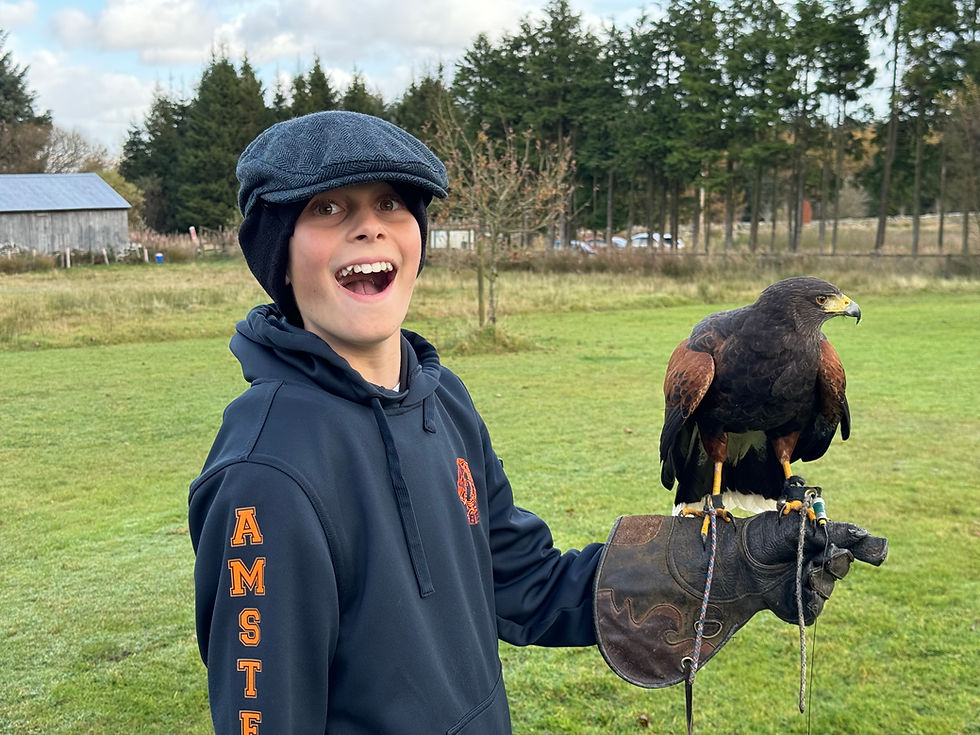
After grabbing a quick lunch in a small English eatery, we made our way onto the car ferry that would take us from Hull, England to Rotterdam, Netherlands. This was an overnight ferry. You literally park your car on the ferry, bide your time for an hour or so, and then head to your cabin where you sleep until the next day when you’re at your destination. With the time change (one week earlier than the US), we docked in Rotterdam Sunday morning at 9am where we disembarked and were home in Amsterdam well before lunch.
Yet another awesome Eu road-trip.


Loved Ireland, that place is magic. Alex looks good in the Mucros Cap:)
-PatG
Wonderful update! I can see the happiness from all three of you. Please keep us posted with your new experiences.
Thanks for the link to part1. Didn't see that. Great to read the whirlwind tour. Was reminded of a fun YouTuber, Beard Meats Food from the UK who generally doesn't have nice things to say about the food there and does a lot of his food challenges in the US, where he generally LOVES all our food.
So, are any of you the types who tried the Full English Breakfast including blood sausage?
Note: this post covers countries 16 and 17 (Scotland and Ireland). Also - from my perspective it was nice to once again be in a country where 1) the signs were in English, 2) the distances were in miles, and 3) they list the destinations on the road sides in order of increasing distance. In the rest of Europe, the road signs are listed in decreasing distance (Berlin 100km, Munich 50km, Bonn 20km). It takes a while to get used to having to look at the bottom of the sign to see what is closest to you.